 Industries
Golden Pineapple
When you think of tropical fruits, a few classics instantly come to mind: mangoes, bananas,…
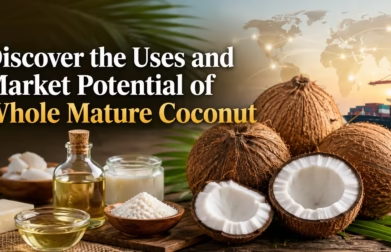
As global markets increasingly prioritize natural, sustainable, and plant-based products, the coconut tree is no longer viewed merely as a familiar tropical crop. It is entering a new role as a strategic source of raw materials for many modern industries. Among its many forms, Whole Mature Coconut stands out as an important link in the agricultural value chain, thanks to its ability to be utilized almost entirely from coconut water, coconut meat, and coconut oil to the husk, fiber, and shell.
The appeal of Whole Mature Coconut lies not only in its value as a food ingredient, but also in its broad application potential across cosmetics, food processing, pharmaceuticals, bio-based materials, and renewable energy. From a seemingly simple coconut, businesses can unlock multiple development opportunities that align with the growing demand for green consumption and sustainable raw materials in international markets.
This article provides an in-depth overview of Whole Mature Coconut, covering its characteristics, application value, role in the supply chain, and future commercial potential. More than just a story about a tropical fruit, it is a story about how a natural resource can create long-term economic value for businesses, producers, and the global market.

Whole Mature Coconut refers to a coconut that has fully developed and reached its mature stage, typically taking around 10 to 12 months from flowering. Unlike Young Coconut, which is mainly harvested for its refreshing water due to its high liquid content and naturally mild sweetness, mature coconut has distinctly different biological characteristics and biochemical properties.
At full maturity, the coconut’s outer husk changes from green to dark brown and becomes dry and firm. Inside, the amount of coconut water decreases significantly, allowing the coconut meat to develop into a thick, dense layer with its highest fat content. This is the stage at which the coconut accumulates its most valuable nutrients, transforming it into a true industrial treasure.
To fully understand its commercial value, we need to break down a Whole Mature Coconut into its basic components. Each component serves as a valuable input for a billion-dollar supply chain:
Coconut Husk: The fibrous outer layer of the coconut, accounting for approximately 35% of the total fruit weight.
Coconut Shell: The hard, protective inner layer that surrounds the coconut kernel, accounting for approximately 12% of the total fruit weight.
Coconut Meat/Copra: The white, nutrient-rich flesh of the coconut, containing a high amount of natural oil and accounting for approximately 28% of the total fruit weight.
Mature Coconut Water: The remaining liquid inside the coconut. Although it is not as sweet as young coconut water, it contains various minerals and accounts for approximately 25% of the total fruit weight.
The utilization of Whole Mature Coconut follows the principle of “Zero Waste” meaning that 100% of the coconut’s components can be commercially used.
The appeal of Whole Mature Coconut does not lie in its outward appearance, but in its exceptional versatility. Let us take a closer look at the applications of each component that makes up a mature coconut.
Mature coconut meat is the most economically valuable component of the coconut. With an oil content ranging from 33% to 38% when fresh and increasing to 60%–70% when dried into copra, it is considered one of the world’s most important sources of plant-based fats.
Refined Coconut Oil (RBD Coconut Oil): Undergoing a refining, bleaching, and deodorizing process, RBD coconut oil is widely used in the food processing industry, including large-scale frying, margarine production, and non-dairy creamers, thanks to its high heat stability and long shelf life.
Desiccated Coconut: Mature coconut meat that is finely shredded or grated and then dried, providing an essential ingredient for the global confectionery and bakery industries, including cake fillings, toppings, chocolate products, and desserts.
Coconut Milk and Coconut Cream: Extracted by pressing mature coconut meat with water, coconut milk and cream are essential ingredients in Asian cuisine, especially in curries and sweet desserts. They are also experiencing rapid growth in Western markets as an ideal dairy-free alternative to cow’s milk for vegan consumers and people who are lactose intolerant.
Coconut shell, once considered a by-product, is now becoming an export commodity with substantial profit margins.
Coconut Shell Activated Carbon: This is one of the most valuable applications of coconut shell. The shell of Whole Mature Coconut has exceptional hardness and a highly distinctive porous structure. When carbonized and activated at temperatures of around 1,000°C, it produces a widely used form of activated carbon. This product is applied in water purifiers, industrial air filtration systems, gas masks, gold mining, and more recently, as a research material for supercapacitors and electric vehicle (EV) battery applications.
Handicrafts and Household Products: With the growing trend of reducing single-use plastics, coconut shells are being processed into coconut bowls, spoons, forks, and decorative items with high export value, particularly favored in European and American markets.
The thick fibrous layer protecting the outer part of a mature coconut is an excellent source of eco-friendly raw material.
Coir Fiber: Coconut fiber has high mechanical strength, strong resistance to saltwater, and excellent resistance to decay. It is woven into floor mats, soil erosion control nets, ropes, and used as filling material for premium eco-friendly mattresses and automotive seat cushions. (2) (3)
Coco Peat / Coir Pith: This is the fine material left after coir fiber is extracted from the coconut husk. Once considered an agricultural by-product, coco peat has become a high-value growing medium thanks to its excellent water retention capacity, high porosity, and ability to support aeration around the root zone. According to FAO documentation, the extraction of 1 kg of coir fiber can generate more than 2 kg of coir pith; this material has been commercialized as a substitute for peat moss in growing media. (4)
Unlike young coconut water, mature coconut water has a slightly tangy taste and a lower sugar concentration. However, in the food industry, it is far from being wasted.
Nata de Coco Production: Through fermentation by the bacterium Acetobacter xylinum, mature coconut water is transformed into a chewy, crunchy, fiber-rich layer of bacterial cellulose. This material is widely used in bubble tea, yogurt, and canned fruit beverages.
Coconut Vinegar and Coconut Aminos: The fermentation of mature coconut water produces organic coconut vinegar and soy-free seasoning sauces that serve as alternatives to traditional soy sauce, catering perfectly to niche consumer markets focused on health-conscious and clean-label products.
The rise of Whole Mature Coconut in global trade is not a temporary trend, but a movement driven by profound shifts in consumer awareness and increasingly stringent environmental regulations.
According to market research reports from Grand View Research and Fortune Business Insights, the global coconut products market is projected to exceed USD 30 billion by 2030, with a compound annual growth rate (CAGR) maintained at around 8%–10%. A significant contribution to this growth comes from mature coconut derivatives, including coconut oil, coconut milk, coconut shell activated carbon, and coco peat. (5)
Key Growth Drivers:
Plant-Based Trend: The rapid expansion of the vegan food market and dairy alternative products has led to exponential growth in demand for coconut milk and coconut cream across North America and Europe.
Clean Beauty Industry: Virgin coconut oil extracted from mature coconut meat is considered a “golden ingredient” in thousands of organic cosmetic formulations, from moisturizers and makeup removers to hair care treatments, thanks to its gentle nature and deep moisturizing properties.
Water Security and Green Energy: Massive demand from water treatment plants and the global battery manufacturing industry is elevating the export value of coconut shell activated carbon to a new level.
At present, the Whole Mature Coconut supply chain is highly concentrated in the Asia-Pacific region, where tropical climate conditions are ideal for coconut cultivation.
Leading Exporting Countries: Indonesia, the Philippines, and India are the three major coconut-producing powerhouses, accounting for more than 70% of global coconut production. Vietnam, Sri Lanka, and Thailand follow closely behind, with a strong focus on producing value-added coconut products. In Vietnam, Ben Tre Province widely known as the country’s “coconut capital” exports millions of whole mature coconuts and related processed products to more than 90 countries and territories. (6)
Key Import Markets: The United States, the European Union particularly Germany, the Netherlands, and the United Kingdom and China are major consumption powerhouses. While China imports large volumes of whole coconuts and refined coconut oil, European and North American markets show strong demand for organic products, cold-pressed coconut oil, and eco-friendly coconut-based products such as coco peat growing media and activated carbon.
Businesses involved in Whole Mature Coconut are no longer limited to selling raw agricultural products; they are increasingly moving deeper into the value chain. International certifications such as Organic (USDA, EU), Fair Trade, and Non-GMO serve as essential passports for coconut products to enter premium supermarket chains such as Whole Foods in the United States, where retail prices can be three to four times higher than those of conventional products.
To provide distributors, importers, exporters, and readers with a clearer quantitative perspective, let us examine the comparative analysis table below. This table highlights why Whole Mature Coconut is considered the “backbone” of the coconut industry, compared with young coconut, which primarily serves the beverage market. (7)
| Evaluation Criteria | Young Coconut | Whole Mature Coconut |
|---|---|---|
| Harvesting Age | 6–9 months | 10–13 months |
| Physical Characteristics | Green outer husk or trimmed white surface, thin and soft coconut meat, and high water content. | Dark brown dry husk, hard coconut shell, and very thick, firm coconut meat. |
| Main Applications | Direct consumption, fresh eating, and packaged coconut water. | Coconut oil extraction, coconut milk production, desiccated coconut, cosmetics, and industrial applications. |
| High-Value By-products | More difficult to process industrially, as young coconut husk contains a high moisture content and is harder to handle. | Activated carbon from the shell, coir fiber, and coco peat from the husk. |
| Oil and Fat Content | Approximately 5.9 g of fat per 100 g. | Approximately 27.4–40 g per 100 g, depending on the sample type; copra can yield around 610 g of oil from 1 kg of copra. |
| Shelf Life | Short, around 2–4 weeks under refrigerated storage conditions. | Longer, around 2–3 months at room temperature, making it easier to transport by sea freight. |
| Profitability Potential | Good gross margin in retail, but with higher spoilage risk during logistics. | Enables 100% zero-waste utilization, with broader profit margins across multiple industries. |
Although Whole Mature Coconut has a long shelf life and a naturally protective hard shell, its cross-border commercialization and export require businesses to comply with strict standards to ensure product quality and prevent the spread of agricultural pests and diseases.
For exported whole mature coconuts, which are often partially or fully dehusked to reduce weight commonly referred to as semi-husked or fully husked mature coconuts the common specifications include:
Weight: Clearly classified by size, for example: Size A: over 1 kg per coconut; Size B: 800 g–1 kg per coconut; Size C: 600 g–800 g per coconut.
Integrity: The coconut shell must be free from cracks and the fruit must show no signs of sprouting. Sprouting is a critical defect because once germination begins, the developing coconut embryo absorbs the fat content from the coconut meat, causing deterioration in quality.
Coconut Eyes: The three coconut eyes at the top of the fruit must be dry, with no signs of mold or water leakage. When the coconut is shaken, the sound of liquid movement should be clearly heard, indicating that the fruit has not dried out or cracked internally.
This is one of the most significant technical barriers when exporting raw agricultural products to markets such as the United States, China, and the European Union.
Fumigation: Shipments must be treated with approved fumigation agents, such as methyl bromide, to eliminate nematodes, insects, and mealybugs that may be hidden in the fibrous husk.
Moisture Control: The husk and coconut meat must meet appropriate moisture standards to prevent mold growth, especially Aspergillus flavus, which can produce highly dangerous aflatoxins during long sea freight journeys lasting 30–45 days.
Whole mature coconuts are commonly packed in mesh bags containing 25, 40, or 50 coconuts per bag to ensure proper ventilation. The use of ventilated containers is essential to prevent heat accumulation, which can cause sprouting or widespread rotting during long-distance sea transportation.
Despite its significant potential, the Whole Mature Coconut industry is also facing global challenges that require coordinated and strategic solutions.
Aging Coconut Plantations: In leading coconut-exporting countries such as the Philippines and Indonesia, a large proportion of coconut trees are aging, with many exceeding 60 years old. This has led to a significant decline in fruit productivity.
Climate Change: Prolonged droughts caused by El Niño, increasingly unpredictable storms and floods, and rising salinity intrusion are reducing coconut yields and affecting fruit size consistency.
Price Volatility: The industry remains highly exposed to fluctuations in global commodity markets, including crude oil prices, as coconut oil is sometimes used as a biodiesel feedstock. It also faces strong competition from lower-cost vegetable oils such as palm oil and soybean oil.
To maintain the competitive advantage of Whole Mature Coconut, different stakeholders across the supply chain are implementing decisive measures:
Coconut Replanting Programs: The adoption of high-yield hybrid coconut varieties can significantly improve productivity, reaching approximately 100–150 fruits per tree per year, while also offering better resistance to pests and diseases.
Blockchain Technology Adoption: Blockchain enables traceability from farm to table, increases transparency throughout the cultivation process, and helps ensure that farmers receive fair prices under Fair Trade principles. This encourages them to maintain and invest in their coconut plantations.
Investment in Deep Processing Machinery: Instead of exporting raw coconuts, investing in automated cold-pressing oil facilities and high-tech activated carbon production plants in producing countries can greatly increase profit margins and strengthen local value creation.
In conclusion, understanding the applications and market potential of Whole Mature Coconut is not merely about exploring the value of a common agricultural product. It opens a strategic perspective on a billion-dollar supply chain where sustainability and economic value go hand in hand.
From nutrient-rich mature coconut meat used to create premium food and beauty products, to rough coconut shells transformed into high-tech filtration materials, and fibrous husks that support clean agriculture, Whole Mature Coconut stands as one of the clearest examples of the Circular Economy in action.
For entrepreneurs, exporters, and strategic investors, Whole Mature Coconut is more than a commercial product; it is a solution to a wide range of essential needs in a world increasingly moving toward greener, cleaner, and more sustainable consumption. With continued market growth expected in the years ahead, investing in, processing, and trading this remarkable fruit represents an attractive, stable, and meaningful business opportunity for decades to come.
Industries Industries
 Industries
 Industries
 Industries